
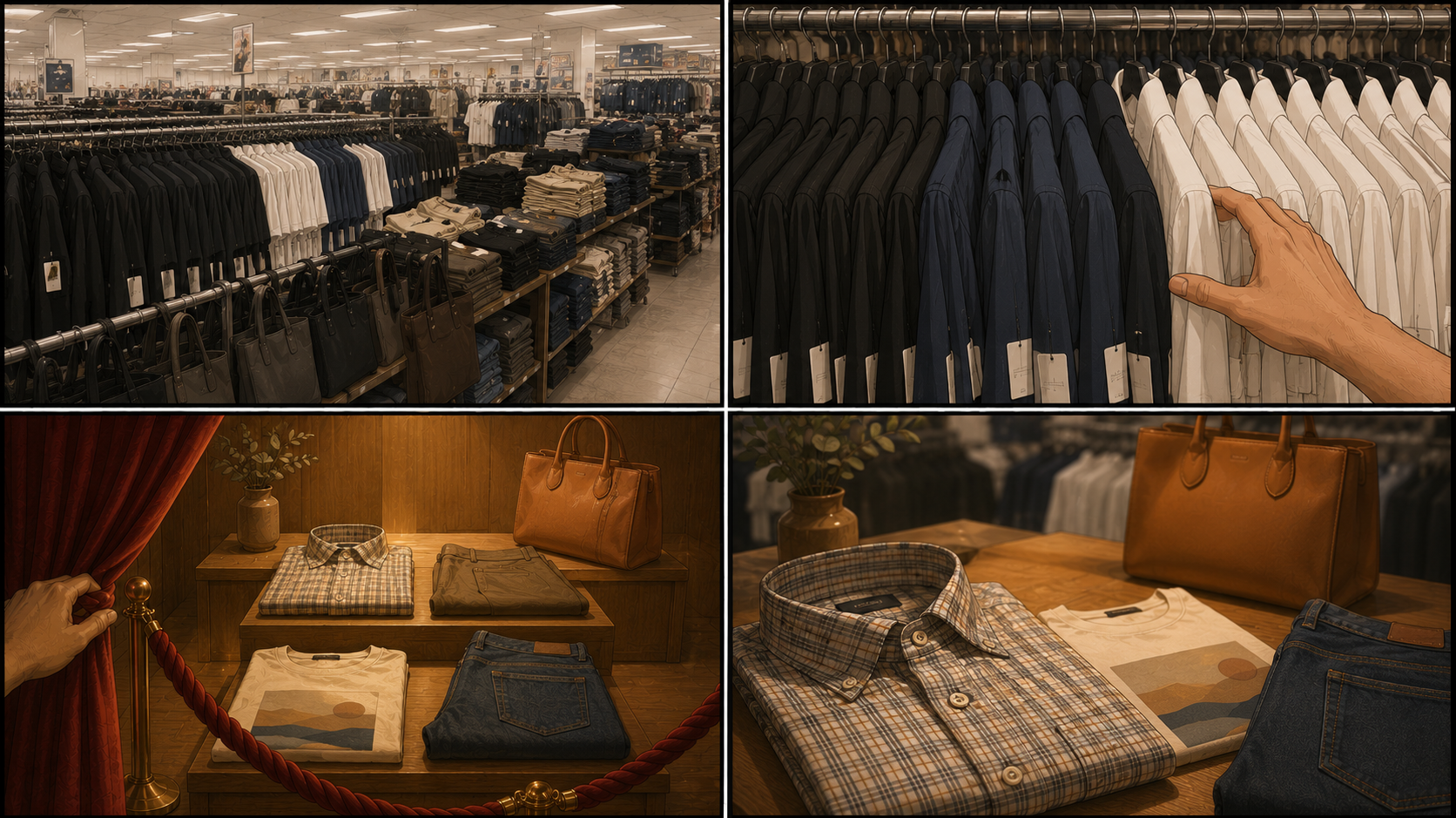
The Indian fashion aisle has historically organised itself around two things that do not particularly serve the average buyer. Mass-market labels priced for volume, where the fabric is the afterthought and the logo is the product. Or imported luxury brands priced for the 0.1 percent, which most Indians encounter primarily on airport concourses while waiting for a flight.
Between those two extremes, a generation of Indian fashion founders has been quietly building the third option. Clothes with actual design intent, made from materials that hold up past the second wash, sold at prices that do not require a separate savings plan. A few of them are doing something more interesting than that.
Six Indian fashion and apparel D2C brands worth your time.
The House of Rare
The origin story matters here because it explains what the clothes actually feel like.
Manish Poddar spent the better part of a decade manufacturing garments for Zara, Jack & Jones and a handful of Italian labels out of his Bengaluru facility. He was on the supply side of European fashion, learning precisely how well-made clothes are constructed, what the materials are, how the fits are cut. In 2015, he and Akshika Poddar launched Rare Rabbit as the thing he had spent a decade making for someone else.
The brand sits in what the industry calls accessible luxury, with an average price point around ₹3,000 for shirts, trousers, jackets, polos and accessories. The design philosophy is deliberately understated: no logos on the chest, European minimalism adapted for Indian proportions, the brand name tucked at the shirt hem in the Italian style. A pair of jeans has two rabbits printed on the inside of the pockets. You would only know if you looked.
The House of Rare has since added Rareism for women and Rare Ones for children, and now operates over 200 stores across India alongside its D2C website. The manufacturing background is the part that holds this together. Rare Rabbit is not a design house that outsources production and hopes for the best. It is a manufacturer that decided to keep the margin.
Explore The House of Rare on D2C Bazaar →
The Bear House
The Bear House launched in 2017 out of Bengaluru after a factory fire set the founders back before they had even started. Tanvi Somaiya, NIFT Mumbai trained, and Harsh Somaiya rebuilt and launched anyway. The brand’s proposition is simple enough to state in a sentence and difficult enough to execute that most brands do not bother: European minimalism cut for the Indian male body, made with the attention to construction that comes from actually knowing how garments are built.
The catalogue is menswear, oversized graphic tees, relaxed-fit jeans, button-down shirts, denim shorts, caps, and check shirts, priced between roughly ₹1,199 and ₹2,599. Nothing here is trying to be a statement piece. The GFINI-OW oversized tee is the kind of shirt that works with three different outfits and does not announce itself. The WAVEL relaxed-fit jeans are built to move like jeans should. The TREK button-down sits between a casual shirt and a lightweight overshirt depending on what you pair it with.
The brand hit ₹140 crore in revenue in FY25 at approximately 18% EBITDA margins, which in apparel is a number that takes actual discipline to produce. It has raised a Series A from JM Financial and now runs 18 stores across 10 Indian cities, plus two outlets in the UAE. The clothes are available on Amazon and Myntra, but the brand’s own website is where the range is fullest.
One honest note: The Bear House uses internal SKU codes as product names on the website. GFINI-OW and WAVEL-MB are not particularly evocative. The clothes are better than the naming system suggests.
Explore The Bear House on D2C Bazaar →
The Pant Project
The Pant Project is solving a problem that Indian men have made their peace with for so long that most have stopped noticing it. Off-the-rack trousers in India fit about 40 percent of the men who buy them adequately and the remaining 60 percent reach for a tailor, resign themselves to the fit or buy and return until something is close enough.
Dhruv Toshniwal (Wharton) and Udit Toshniwal (Art Institute Chicago) launched The Pant Project in 2020 with a straightforward proposition: custom-fit trousers ordered online, delivered to your door. You submit your measurements once, they build a fit profile from it, and every pair you order after that is cut to those measurements. The brand claims 93% first-order accuracy on fit, and alterations are free when they are needed.
The range covers formal trousers, stretch chinos, relaxed-fit casuals, cargo pants, and jeans, with prices running from around ₹2,990 to ₹3,990 depending on the style and fabric. Power-stretch versions use a polyester-viscose-elastane blend that moves with you through a twelve-hour workday. The formal trouser range uses wool and premium cotton. The fit data now covers over 100,000 Indian men, which is a meaningful proprietary asset, not many brands know that much about how Indian male bodies actually vary.
The brand currently operates 15 physical stores and is building toward 120-150 stores. The store experience is the measurement consultation done properly, which is what makes the trouser land right the first time.
Explore The Pant Project on D2C Bazaar →
Virgio
Virgio started in 2022 as a fast fashion brand. By late 2023, Amar Nagaram, who built Myntra into the platform it became before leaving as CEO in 2021, had concluded that fast fashion was, in his own description, “no less than any devil,” and pivoted the entire company toward sustainable and circular fashion.
The pivot is not cosmetic. The catalogue is built from recycled polyester, organic cotton and viscose. Every garment ships with a digital fashion passport, a scannable tag that shows the environmental footprint of that specific piece, where the fabric came from, how it was made. The brand has PETA Approved Vegan certification. Pricing is transparent to a degree that is unusual in fashion: the cost breakdown for each product is published, and Virgio’s “Eco-nic Fair” in 2025 took the premise further, selling products at manufacturing cost with no margin for one day.
The catalogue is primarily women’s dresses, co-ords, tops, trousers and the Beyond the Curve plus-size line. The Amodira fragrance line is a separate but adjacent thing, Indian-heritage perfumery positioned in the luxury tier. The brand now has standalone stores in Bengaluru, Delhi, Ahmedabad, and several other cities, plus international operations.
The backstory from Myntra matters for context. Nagaram ran one of India’s largest fashion platforms and watched the volume model up close. Virgio is the deliberate inversion of that.
Explore Virgio on D2C Bazaar →
Miraggio
The Indian handbag market has had a persistent gap between two categories. Mass-market bags from fast-fashion labels, priced low and built accordingly. Imported European brands priced somewhere above what most people want to spend on a bag that will get rained on in a Mumbai monsoon. Miraggio has spent several years filling the space between them.
Founded in 2019 by Mohit Jain in Gurugram, Miraggio designs in-house with a team that includes both Indian designers and external consultants, then manufactures across Asia. The result is a catalogue of over 350 SKUs: satchels, totes, crossbody bags, and shoulder bags, priced at an average of around ₹3,000. The brand sells through its own website and across Myntra, Amazon, Ajio, Nykaa and Tata CLiQ.
The positioning is deliberate. Miraggio is twice the price of the average Indian handbag and a fraction of the price of the European alternatives it competes with aesthetically. The brand has grown at 120% year on year in a category that is projected to reach nearly $2 billion by 2025, which suggests the gap it identified was real. The aesthetic skews toward clean shapes, neutral colorways, and structured silhouettes, the kind of bag that reads expensive from across the room without requiring a visible logo to explain why.
Explore Miraggio on D2C Bazaar →
MyDesignation
MyDesignation is a Kerala story. Swaroop Krishnan and Gopika Menon started the brand in Thiruvananthapuram in 2020, frustrated, as they describe it, by the absence of expressive, occasion-ready clothing at prices that most people could actually afford. The brand’s tagline is “Wear Your Vibe,” which sounds like marketing shorthand until you look at the catalogue and realise it is a reasonably accurate description of what they are doing.
The product is primarily men’s printed tees, oversized shirts, hoodies, polo shirts, and linen pieces — graphic-heavy, culturally specific, drawing from South Indian heritage, mythology, and global streetwear in the same breath. An Ajrakh floral polo sits alongside an anchor oversized tee. A “Pride of India” collection runs alongside the summer linen range. The brand drops new designs periodically rather than maintaining a static catalogue, and the community, 650,000 Instagram followers actively involved in product feedback, shapes what gets made.
Pricing is accessible: most tees sit around ₹999, polo shirts around ₹1,199, with the brand operating a largely D2C-only model that keeps the margin intact. A 35% monthly repeat rate and a customer base that has crossed one million suggests the community-building approach is working. The brand has since raised ₹40 crore to expand offline across India, with five stores already operating in South Indian cities.
Explore MyDesignation on D2C Bazaar →
There are more fashion and apparel brands worth exploring on D2C Bazaar → Indian Fashion and Apparel D2C brandsWhich Indian D2C fashion brands are worth knowing?
The House of Rare for premium menswear with a manufacturing-first background, The Bear House for European-minimalist menswear at accessible prices, The Pant Project for custom-fit trousers ordered online, Virgio for sustainable and circular women’s fashion, Miraggio for premium handbags in the ₹2,000 to ₹4,000 range, and MyDesignation for graphic-led streetwear rooted in South Indian culture and heritage.
Is there a good Indian D2C brand for custom-fit trousers?
The Pant Project makes custom-fit trousers ordered online, delivered across India. You submit measurements once and the brand builds a fit profile from them. Formal trousers, stretch chinos, relaxed casuals, and jeans are all available with free alterations if the first order needs adjustment. Prices run from around ₹2,990 to ₹3,990.
Are there Indian sustainable fashion brands worth buying?
Virgio makes women’s clothing from recycled polyester, organic cotton, and viscose, with a digital fashion passport on every garment showing its environmental footprint and supply chain. The brand has PETA Approved Vegan certification and publishes its cost breakdowns transparently. It was founded by Amar Nagaram, former CEO of Myntra.
What is the best Indian premium menswear D2C brand?
Rare Rabbit, under The House of Rare, is one of the more established names in this space. The brand was started by Manish Poddar, who spent a decade manufacturing for Zara and European labels before launching his own. Shirts, trousers, jackets, and accessories sit around an average price of ₹3,000, with a minimalist design approach and over 200 stores across India.
Is Miraggio a good Indian handbag brand?
Miraggio designs premium handbags, satchels, totes, crossbody bags, and shoulder bags with an average price around ₹3,000. The brand designs in-house and sells through its own website alongside Myntra, Amazon, Ajio, Nykaa, and Tata CLiQ. It positions itself in the gap between mass-market and imported luxury, and has grown at 120% year on year in a category projected to reach $2 billion by 2025.
What are Indian D2C fashion brands?
Indian D2C fashion brands sell clothing and accessories directly to consumers online, bypassing traditional retail. The better ones use this model to maintain tighter control over design, fabric sourcing, and price and often offer things the mass-market channel cannot, such as custom fits, transparent supply chains, or sustainable materials at accessible price points.
Comments