
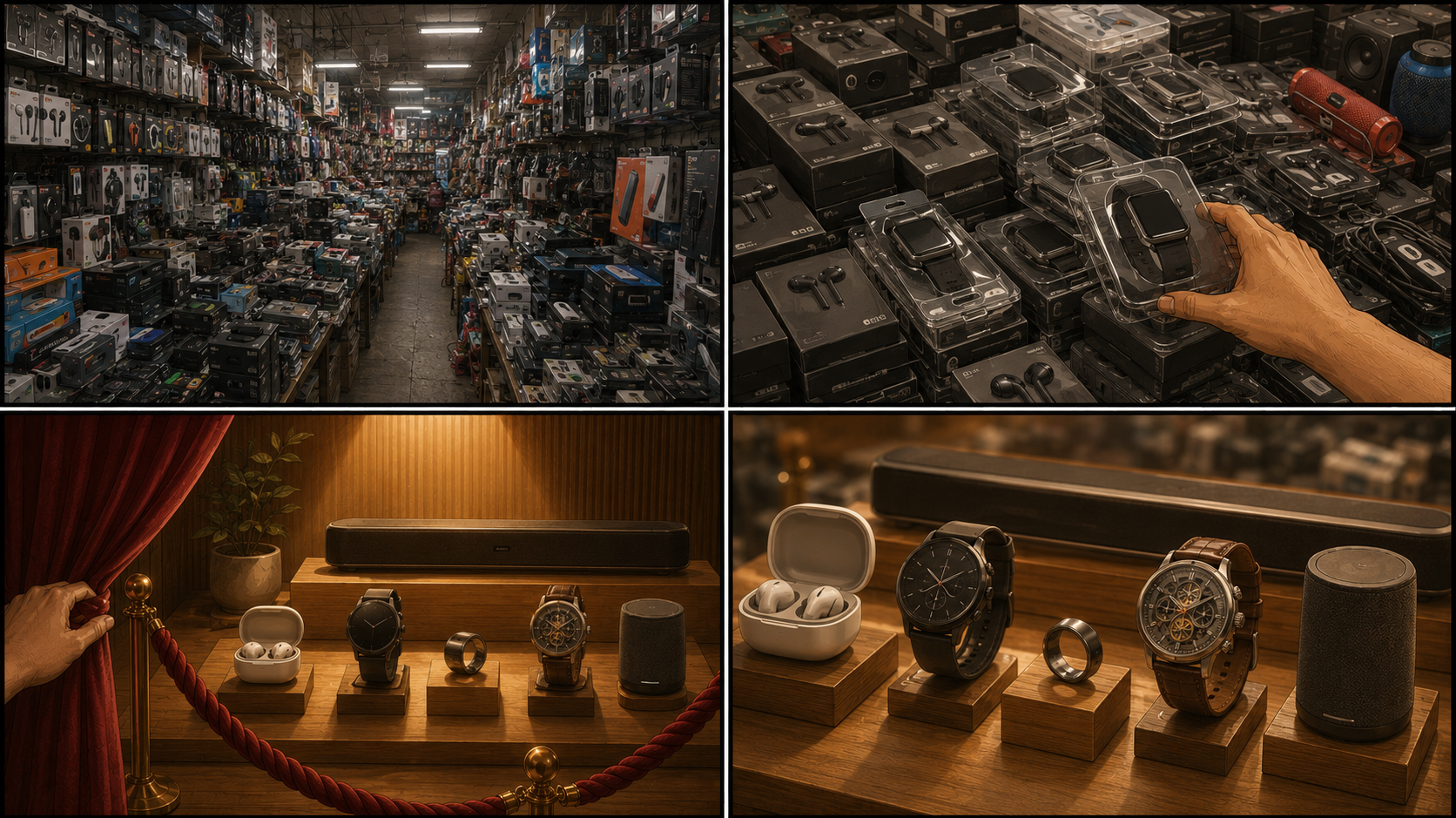
For most of the last twenty years, the assumption sitting under any Indian electronics purchase was the same. The brand worth buying came from somewhere else. Sony for headphones, Apple for watches, Garmin for fitness, Swiss labels for proper analog timekeeping. Indian electronics meant cheap, cheerful and a little embarrassing to put on a coffee table.
That assumption has not aged well. In the last few years, a generation of Indian electronics brands has built genuinely competitive product at almost every tier of the market. Mass-market audio for ₹1,000 that holds its own against ₹4,000 imports. AI-grade smart rings that track 70+ biomarkers and won a Red Dot. Mechanical analog watches assembled in Delhi with Swiss components. The diversity in this list is the point.
Six Indian electronics and tech D2C brands we think are worth your time, each doing something genuinely different from the next.
boAt
The boAt range is the closest thing India has to a default audio brand. Walk into any college canteen, gym, or local train and the earbuds you see are usually theirs. The catalogue depth explains the dominance.
The Airdopes line is the bestseller core. Airdopes 161 at around ₹1,099 with 60 hours of total playback. Airdopes Alpha at ₹999 with 17-hour playback and engraving option. Airdopes 311 Pro at ₹899 with 100-hour total playback and Beast Mode for gaming latency. Airdopes 181 Pro at ₹1,199 with 76 hours and ENx noise cancellation tech. Drivers range from 10mm to 13mm depending on the model. The brand’s proprietary ASAP charging gives roughly an hour of playback from a ten-minute charge across most of the range.
Around that core sits the rest of the catalogue. Rockerz neckbands and headphones (the Rockerz 255 Pro+ at ₹999, Summit at ₹1,199 with dual pairing, Trinity at ₹1,499 with Beast Mode). Stone Bluetooth speakers with IPX5 ratings. Aavante soundbars. Wave and Storm smartwatches. Mobile accessories. The Nirvana Ion premium TWS with 120-hour playback and HiFi DSP 5 for those who want to spend a little more.
The pitch is simple. Most people buying audio in India do not need ₹15,000 headphones. They need a pair of wireless earbuds that work well, last a workout, charge fast and survive being dropped in a bag every day. boAt built that product, priced it correctly, and committed to it at scale. Indian audio became a category most people stopped looking abroad for, and boAt is the largest reason why.
Mivi
The label on the side of the box says “Made in India.” Mivi is one of the few audio brands where that is not a marketing line. The company designs, engineers and manufactures its products at its own Hyderabad facility, which makes it India’s first audio tech brand with a fully owned domestic manufacturing operation.
The DuoPods range is the heart of the catalogue. DuoPods A25 at around ₹1,099, 13mm bass drivers, 40 hours of playback, IPX4 splash protection. DuoPods i2 at ₹999, 45-hour playback with AI-ENC for clear calls, gaming mode for low-latency play. DuoPods i3 at ₹1,599 with 60 hours. DuoPods D4 at ₹1,399 with 50 hours and a secure in-ear fit. The newer Roar variant adds 70-hour battery and IPX4 rating. There is also a Superpods range at the premium end, and the AI Buds line that integrates Mivi’s own AI assistant.
The catalogue widens out from earbuds into a fairly complete domestic audio stack. Collar neckbands like the Flash. Bluetooth speakers including the Fort S24. Soundbars across multiple price tiers. Bundles that combine earbuds with neckbands or speakers at ~50% savings on combined retail. The build quality holds up against the imported competition at the same price point, which is the part the manufacturing investment was meant to deliver.
For buyers who care about where their electronics are actually made (and increasingly, that means most domestic buyers), Mivi is the brand that put the manufacturing where the marketing claims it is. The product just happens to be good as well.
Noise
If boAt’s specialty is audio at scale, Noise’s specialty is the wearable. The brand has spent the last several years building the most extensive Indian smartwatch catalogue, and more recently, expanding into smart rings.
The ColorFit range is the dominant series. ColorFit Pulse Grand at around ₹1,999 with a 1.69-inch HD display, 60 sports modes, and SpO2 tracking. ColorFit Ultra with a 1.75-inch TruView display, aluminium alloy body, 60 sports modes with auto-detection, and IP68 water resistance. ColorFit Icon 2 with a 1.8-inch display and Bluetooth calling at the entry tier. Newer launches in the Pro 6R series with a 1.46-inch AMOLED display and 1000 nits brightness for visibility in Indian summer light. Force 2 for the rugged build. Twist Go with metal finish. Vortex Plus with AMOLED and BT calling.
The smart ring tier is where the brand is doing its most interesting recent work. The Luna Ring is an AI-powered smart ring that tracks more than 70 body metrics, including stress, sleep stages, heart rate variability, and women’s health markers. It won a Red Dot award, has shown at CES 2025, and represents the first Indian wearable being seriously pitched at the global market on engineering rather than price.
Bose backed the brand as a global audio partner. The ColorFit smartwatches dominate the affordable smartwatch shelf at Indian retail. The Luna Ring is the part of the catalogue worth watching, because it is the first time an Indian wearable brand has built a product designed to compete with Oura and Whoop on the science, not the discount.
Rotoris
Most of this list is consumer electronics in the conventional sense. Rotoris is not. The brand makes mechanical analog watches, designed in India and assembled at the brand’s New Delhi facility, with components sourced from Switzerland, Italy, and Asia depending on the specification. The product is closer to a precision engineering exercise than a consumer gadget.
The launch catalogue is built around the principle of limited allocation. 2,100 numbered watches are available in the initial run, each individually numbered with a transparent ownership registry. Production runs are deliberately small. The movements are mechanical (not battery, not quartz) and the design language sits at the intersection of luxury, individuality, and modern aesthetics rather than the conservative dress-watch territory that legacy Indian horology has traditionally occupied. Pricing and exact specifications are still rolling out as the brand staggers its launches through 2026, with men’s watches the initial focus.
The wider plan is more ambitious than the watches themselves. The long-term goal is a formal Swiss manufacturing partnership, which would make Rotoris one of the very few Indian brands with a European production foothold in horology. An experience store in New Delhi is on the horizon. The community side of the brand is being built around the numbered ownership, the registry and direct relationships with collectors rather than the usual influencer marketing playbook.
For buyers who care about mechanical watchmaking and have historically had to look at Tag Heuer or Longines for anything in this segment, Rotoris is the first credible Indian alternative. The proof is still ahead of the brand. The ambition is unmistakeable.
Explore Rotoris on D2C Bazaar →
Ultrahuman
Most fitness wearables tell you how much you walked, slept and burned. Ultrahuman built a platform that tells you what is happening underneath those numbers, including how your body is processing the food you ate three hours ago.
The Ultrahuman Ring AIR is the entry product. A non-invasive smart ring with hypoallergenic materials and a tungsten carbide coating for daily durability, designed for continuous wear. It tracks sleep stages, movement, recovery, HRV, skin temperature and stress. The form factor sits naturally next to your everyday rings and is light enough to wear overnight, which is when the most valuable data is captured.
The Ultrahuman M1 is the brand’s distinguishing product. A semi-invasive continuous glucose monitor (CGM) that uses a small sensor on the upper arm to track real-time glucose response to food, exercise, and sleep. Pricing for M1 starts at around $299 for a one-time purchase or $249 on subscription. The data flows into the Ultrahuman app, which generates a Metabolic Score (the brand’s proprietary measure of glucose stability through the day) and a food score (1 to 10) for each meal showing how much that specific food spiked your glucose. The Ring and M1 work together: combine glucose data with sleep stages and movement, and the app surfaces correlations no individual product could.
The Ultrahuman Home is an ambient sleep monitor that tracks air, light, and sound. The Ultrahuman Photon is a precision red light therapy device for muscle recovery. The brand has published actual research on the platform through Ultrahuman Science, including peer-reviewable studies on metabolic health in non-diabetic and pre-diabetic Indians using M1.
This is the brand for the buyer who treats their own health like a system that can be measured and tuned. Not the casual fitness band buyer. The one who actually wants to know whether the dosa raised their glucose more than the rice.
Explore Ultrahuman on D2C Bazaar →
FireBoltt
Fire-Boltt was, at one point, India’s number one wearable brand by IDC quarterly tracker numbers, which tells you everything about how seriously the brand approaches the smartwatch category. The catalogue is built around making the AMOLED + Bluetooth calling smartwatch experience accessible at every price point.
The catalogue runs deep. The Cobra at ₹1,199 is a military-grade rugged smartwatch with a 45.2mm AMOLED display, IP68 rating, and passes 12 MIL-STD-810 toughness tests including extreme heat, cold, and humidity. The Invincible at ₹5,999 sits at the premium end with a 1.39-inch AMOLED, Bluetooth calling, 8GB internal memory for storing up to 1,500 songs, and IP67 swim rating. The Axiom at the mid-tier brings a 1.43-inch AMOLED with 1000 nits brightness, always-on display, wireless charging, and a rotating crown with dual button pushers. The Talk and Talk Pro lines focus on Bluetooth calling at affordable prices, the Visionary brings a 1.78-inch AMOLED for those who want a larger display, and the Legacy and Legacy Force lines target the metal-build premium category.
The breadth is the point. Bluetooth calling smartwatches in India used to cost ₹15,000+ when they first arrived. Fire-Boltt brought the feature to ₹1,500 to ₹3,000 without quietly removing the actual functionality. AMOLED displays at every tier. SpO2 and heart rate tracking standard. Multiple sports modes (often 100+). The build varies appropriately with the price, but the core feature set holds even at the entry level.
This is the brand for the buyer who wants a serious smartwatch without paying serious smartwatch prices. The Cobra rugged variant for outdoor use. The Axiom for the office. The Talk for daily wear. Different watches, same engineering discipline across the catalogue.
Explore Fire-Boltt on D2C Bazaar →
There are more electronics and tech brands worth exploring on D2C Bazaar → Indian Electronics and Tech D2C brandsWhich Indian D2C brands are worth knowing in electronics and tech?
boAt for mass-market audio, Mivi for fully Indian-manufactured audio products, Noise for smartwatches and the AI-powered Luna Ring, Rotoris for mechanical analog watches, Ultrahuman for the smart ring and continuous glucose monitoring platform, and Fire-Boltt for affordable AMOLED smartwatches with Bluetooth calling. Each one operates in a meaningfully different segment of electronics and tech.
Which Indian electronics brand actually manufactures its products in India?
Mivi is the most clearly identifiable example. The brand designs, engineers, and manufactures its earbuds, speakers, and soundbars at its own Hyderabad facility, making it India’s first audio tech brand with 100% in-house domestic manufacturing for audio products.
Is there an Indian alternative to Oura Ring or Whoop for health tracking?
Yes. Ultrahuman Ring AIR is a non-invasive smart ring that tracks sleep stages, movement, recovery, HRV, and skin temperature, and can be paired with the Ultrahuman M1 continuous glucose monitor for metabolic health tracking. The Noise Luna Ring is another option, with AI-driven insights across 70+ body metrics and a Red Dot award for design.
Are there Indian mechanical analog watch brands?
Rotoris is the most credible recent entry. The brand designs watches in India, assembles them at its New Delhi facility, and sources mechanical movement components from Switzerland, Italy, and Asia. The initial launch is limited to 2,100 numbered watches with a transparent ownership registry, and the long-term plan includes a Swiss manufacturing partnership.
Which Indian smartwatch brand has the strongest AMOLED catalogue at affordable prices?
Fire-Boltt has built one of the deepest AMOLED smartwatch catalogues at the affordable end. Watches like the Cobra (₹1,199, rugged AMOLED, military-grade durability) and the Axiom (1.43-inch AMOLED with 1000 nits brightness and wireless charging) bring AMOLED + Bluetooth calling features that historically cost ₹10,000+ down to a much lower price band.
What are Indian electronics and tech D2C brands?
Indian electronics and tech D2C brands sell directly to consumers online, cutting out the distribution and retail markup that traditionally inflated prices on imported gadgets. The better ones use that pricing control to invest in product engineering, manufacturing, or specialised health science research, the kinds of things mass-market electronics brands historically had to outsource or import.
Comments