
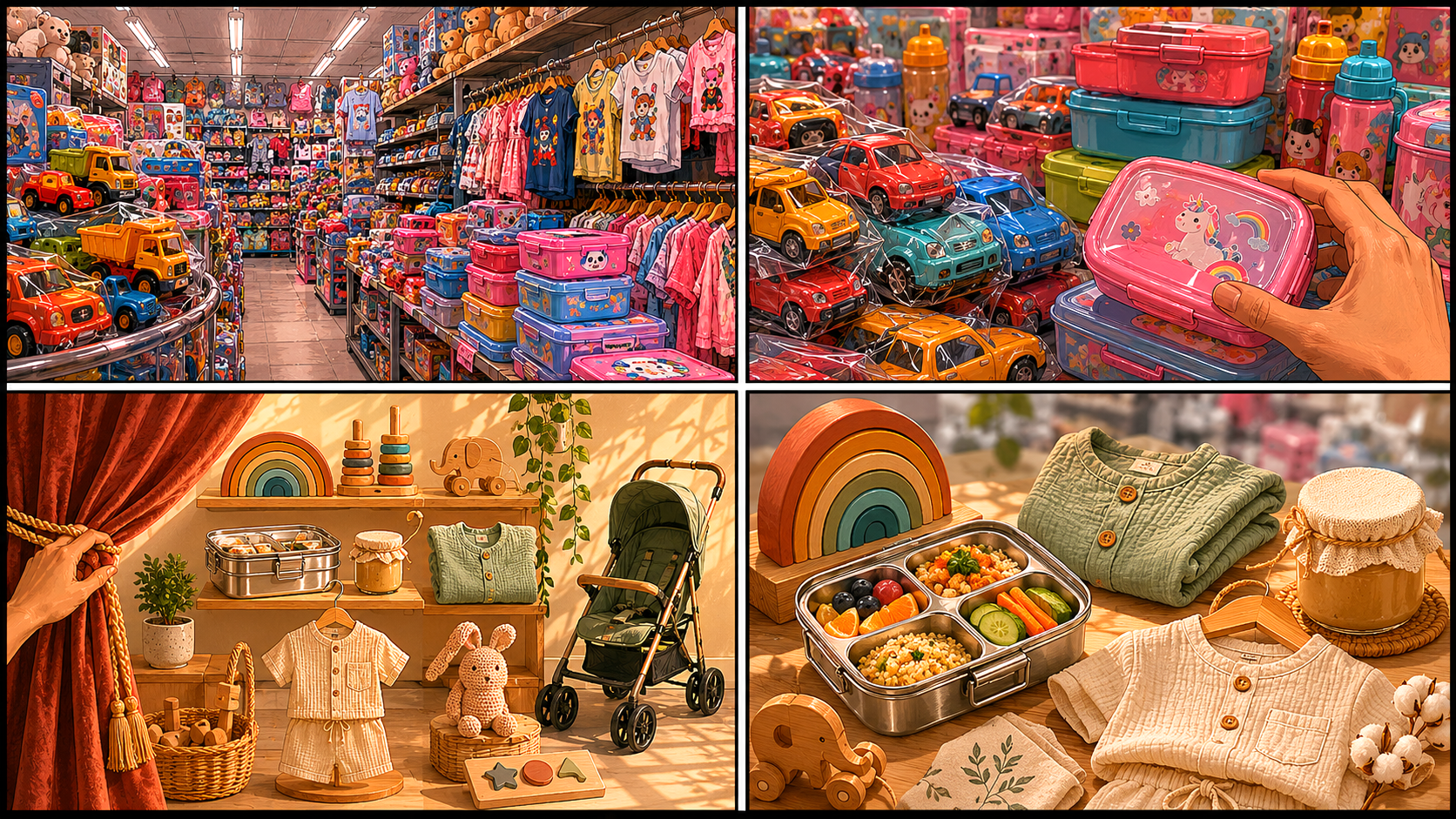
The Indian baby and kids aisle has historically asked you to pick from two columns. International brands priced like they were meant for someone else’s currency. Or domestic options where “functional” was the kindest available adjective.
Somewhere in the last few years, a quieter shift has been happening. Lunchboxes designed from a five-year-old’s perspective. Strollers that take Indian gravel personally. Toys that look like someone read the Montessori literature instead of the toy industry briefs. None of it shouted. But the products are there.
Six Indian baby and kids D2C brands we think are worth your time.
Basil
A child has to be able to open their own lunchbox. This sounds obvious until you watch a five-year-old struggle with a latch built for an adult and quietly call a teacher over for help every single day.
Basil’s bento boxes are designed around that exact moment. The smooth-click latches are deliberately calibrated, not so loose that the box leaks, not so tight that small hands can’t open them. The boxes are 304 food-grade stainless steel with food-grade silicone seals, three or four compartments depending on the model, BPA-free, designed for kids aged five and up. The seal handles wet food like dips, sauces and yoghurt without letting them mix between compartments. It is not meant for runny liquids like water. They are not insulated and do not keep food warm, which the brand says upfront on every product page.
The range covers bento boxes in playful prints (Aqua Mist, Pixie Dash, Hocus-Docus dino, Coral Swirl) plus matching water bottles, insulated food jars with sporks, and bags. The print durability is honest about its limits: handle the box with care, avoid the dishwasher and metal scrubbers, and the design lasts. Run it through the dishwasher and the print will eventually peel.
The reviews repeat themselves in a way that tells you something. Parents talk about the leak resistance and the build. Kids talk about wanting to actually carry the thing to school. Most lunchboxes can manage one of those. Basil seems to have figured out both.
Nesta Toys
The thing that gives a Nesta toy away is the silence. No batteries, no chimes that play the same six notes on a loop, no flashing lights designed to grab a parent’s eye in a shop and never let go. Just wood, cotton and an idea about what play is for.
The range is built around open-ended Montessori principles: a child decides what the toy is for, not the box. The sensory wooden tray, one of the brand’s most-bought sets, is a six-piece kit (wooden tongs, spoons, scoops, and a cup) on a beech wood Montessori tray. It costs around ₹1,500. Children scoop rice. Pour beans. Sort objects. Practise the fine motor coordination that, in a few years, will turn into the ability to hold a pencil. None of which sounds like a “toy” until you watch a two-year-old spend forty-five minutes doing it.
The wider catalogue runs through wooden puzzles (India maps, world maps, animals), pretend play kits (kitchens, doctor sets, tool kits), stacking blocks, phonics flashcards designed to teach reading in twenty stages, and a small range of STEM-leaning toys for older children. Materials are beech wood and ply, finishes are non-toxic, edges are rounded. Several sets specifically support children with sensory integration needs, ADHD, or autism, which is unusual to find on an Indian toy site without it being a marketing line.
This is not the brand for a child who has been promised something flashing and noisy. It is the brand for the parent who wants to spend a Sunday morning watching the child concentrate, which, it turns out, is a thing children are perfectly capable of doing if you give them the right material to concentrate on.
Explore Nesta Toys on D2C Bazaar →
Loopie
Most strollers sold in India were designed for European pavements. The Loopie Hop was not.
The Hop is the brand’s centrepiece product and currently retails around ₹17,999, though the bundle with the car seat and diaper bag sits closer to ₹19,799. It weighs 8.4 kg, folds one-handed, fits cabin baggage dimensions for most Indian airlines, and is rated for children from birth up to roughly 22 kg or four years. The frame is aluminium. The seat fabric is Oxford cotton, which matters in May in Delhi. The canopy is UPF 50+.
The features parents notice once they actually use it: the front wheel suspension dampens the small repeated jolts you get on uneven Indian pavements, the rear wheels are large EVA, the front wheels swivel 360 degrees but can be locked for rougher ground, the brake is one-step. The seat reclines through multiple positions including a flat sleep mode for naps. The footrest adjusts three ways and folds up to form a safety barrier for infants. The harness is five-point with a magnetic buckle, which is the kind of thing that sounds excessive until you try buckling a wriggling baby with cold hands.
The catalogue is still focused. The Hop. The Lap convertible car seat. The diaper bag. A few accessories: stroller bag, rain cover, mosquito net, infant seat insert. That is the whole brand right now. The argument for buying it sits on whether the Hop is the right stroller for your specific situation. If you walk on Indian pavements, fly with a baby, or live in an apartment where folding matters, it tends to be the right one.
Explore Loopie on D2C Bazaar →
Bebe Burp
A six-month-old needs food. The choices on most Indian shelves are imported jars at imported prices, or domestic mixes that quietly include enough sugar and starch to give an adult pause. Bebe Burp built the version a grandmother would have made if grandmothers came in sachets.
The flagship product is the porridge mix, sold either as 200 g packs of single varieties or as a sample box of six 30 g packs. The cooking instruction takes one line: add four spoons to two cups of boiling water or milk, cover for five minutes, stir. No stove time. No pre-cooking. The mix porridge contains broken wheat, split Bengal gram, a small spice blend (cumin, ajwain, asafoetida), jaggery, freeze-dried banana and beetroot. The barley mix uses pearl barley with the same spice profile, jaggery, and freeze-dried banana and strawberry. The puffed rice porridge, ragi porridge, finger millet mix and instant khichdi cover the rest of the early weaning range.
The defining choice is what is not in any of them. No refined sugar; the sweetness comes from jaggery, dates or the freeze-dried fruit. No preservatives. No artificial colours or flavours. No added vitamins or minerals, which the brand argues should come from the grains themselves. The product range extends into puffs for slightly older babies, ragi-based snacks for crawling and walking stages, kid-friendly cookies and Tasty Tots ready meals, plus single-serve travel packs for parents who do not want to repack porridge into pouches at airports.
For working parents who care about the ingredient list and do not have time to make porridge from scratch every morning, this is the brand that quietly solves both problems at the same time.
Explore Bebe Burp on D2C Bazaar →
Kidbea
Bamboo viscose is softer than cotton, naturally anti-bacterial, breathable, and forgives the average Indian summer in ways most synthetic fabrics simply do not. Kidbea built an entire kidswear catalogue on that one observation.
The Bamboo Bliss range is the heart of the brand: rompers, T-shirts, co-ord sets, jhablas, frocks, vests and camisoles, all in bamboo viscose, sized from newborn through toddler. The base romper sits around ₹549, which positions Kidbea well below the imported bamboo brands and roughly in line with conventional kidswear made from heavier fabrics. There is also a Light Linen collection for older toddlers, a partywear range with slightly more structured pieces and a small range of accessories including sippers and bottles.
What stands out across the catalogue is the diaper-friendly engineering. Bottom snaps on the rompers for fast changes, front snap buttons rather than over-the-head pulls for newborns, prints that hold up to the laundry cycle a baby actually puts clothing through. The fabric does not stiffen after a wash the way conventional cotton does in Indian water and the breathability is the part babies seem to notice. Fewer prickly heat rashes during summer in cities that get genuinely uncomfortable.
The pricing logic is what makes the brand work. Bamboo kidswear in India has historically been a premium import category. Kidbea made it the default category at a price point Indian parents can actually pay for everyday wear, not just one special outfit.
Explore Kidbea on D2C Bazaar →
Nap Chief
Children develop loyalty to a character (Mickey, Spider-Man, Hermione, Pikachu) long before they develop loyalty to a brand. Nap Chief noticed and built the entire wardrobe around that fact.
The catalogue is licensed character merchandise done properly. Officially licensed prints from Disney, Marvel, DC Comics, Harry Potter, Tom & Jerry, Pokémon, Naruto, Hello Kitty, Paw Patrol, Frozen, Looney Tunes, Garfield, SpongeBob and ISRO. Co-ord sets, pajama sets, hoodies, joggers, shorts sets, tee-and-jogger combos, T-shirts, dresses, and a winter range. All 100% cotton on the home and play wear, sized for boys and girls from infant through 13-14 years. Prices sit in genuine value-for-money territory. A co-ord set goes for around ₹990 to ₹1,290, pajama sets from ₹1,049, with frequent discounts on offer.
The Family Twinning collection is the part of the brand that has taken off most visibly. Matching outfits for parents and kids, in the same prints, sized through adult XL and beyond. Iconic Mickey co-ords for ₹990 across the whole family. Pokémon co-ords. Harry Potter flannel pajamas. The product is designed for the kind of parent who likes a slightly self-aware Sunday morning photograph, which, judging by the catalogue depth, is a larger demographic than anyone previously suspected.
The pitch is straightforward. Children want to wear what they recognise. Most Indian kidswear brands ignore that completely or pretend it does not matter. Nap Chief leaned in, paid for the licensing, and built a brand that knows what it is.
Explore Nap Chief on D2C Bazaar →
There are more baby and kids brands worth exploring on D2C Bazaar → Indian Baby and Kids D2C brandsWhich Indian D2C brands are worth knowing for baby and kids essentials?
Basil for school lunchboxes and bento boxes designed for small hands, Nesta Toys for Montessori-aligned wooden toys, Loopie for strollers built for Indian roads, Bebe Burp for clean-label baby porridge, Kidbea for affordable bamboo kidswear, and Nap Chief for officially licensed character clothing. Each one solves a specific problem rather than trying to be a general kids brand.
Are there Indian baby food brands without preservatives or added sugar?
Bebe Burp is built specifically around this. The porridge mixes use grains like wheat, barley, ragi, and millet with jaggery or freeze-dried fruit for sweetness rather than refined sugar. No artificial colours, flavours, or preservatives. The cooking instruction is just hot water and five minutes, no stove time required.
What is a good Indian kids clothing brand for bamboo or organic fabric?
Kidbea makes its core kidswear range from bamboo viscose, which is breathable, anti-bacterial, and softer than cotton. A bamboo romper starts at around ₹549. The catalogue covers rompers, T-shirts, co-ord sets, jhablas, frocks, and vests, sized newborn through toddler, with diaper-friendly snap closures throughout.
Are there Indian D2C kids brands built around Montessori principles?
Nesta Toys is the clearest Montessori-aligned brand in this space. The range covers wooden sensory toys, puzzles, stacking blocks, pretend play kits, and STEM toys, all built from beech wood, ply, and natural materials with non-toxic finishes. Several sets are specifically designed to support children with sensory integration needs, ADHD, or autism.
Which Indian stroller is built for Indian roads and apartment living?
The Loopie Hop is built specifically for this combination. Front wheel suspension and large EVA rear wheels handle uneven Indian pavements. The one-hand fold and 8.4 kg weight make it manageable in apartment lifts and on stairs. It folds cabin-bag small for flights and is rated for children from birth up to roughly four years.
What are Indian baby and kids D2C brands?
Indian baby and kids D2C brands sell directly to parents online, cutting out the distribution and retail layers that typically add cost without adding quality. The better ones use that control to invest in fabric standards, ingredient sourcing, or design specifically for Indian conditions, the kinds of things mass-market brands operating through wholesalers struggle to do consistently.
Comments