
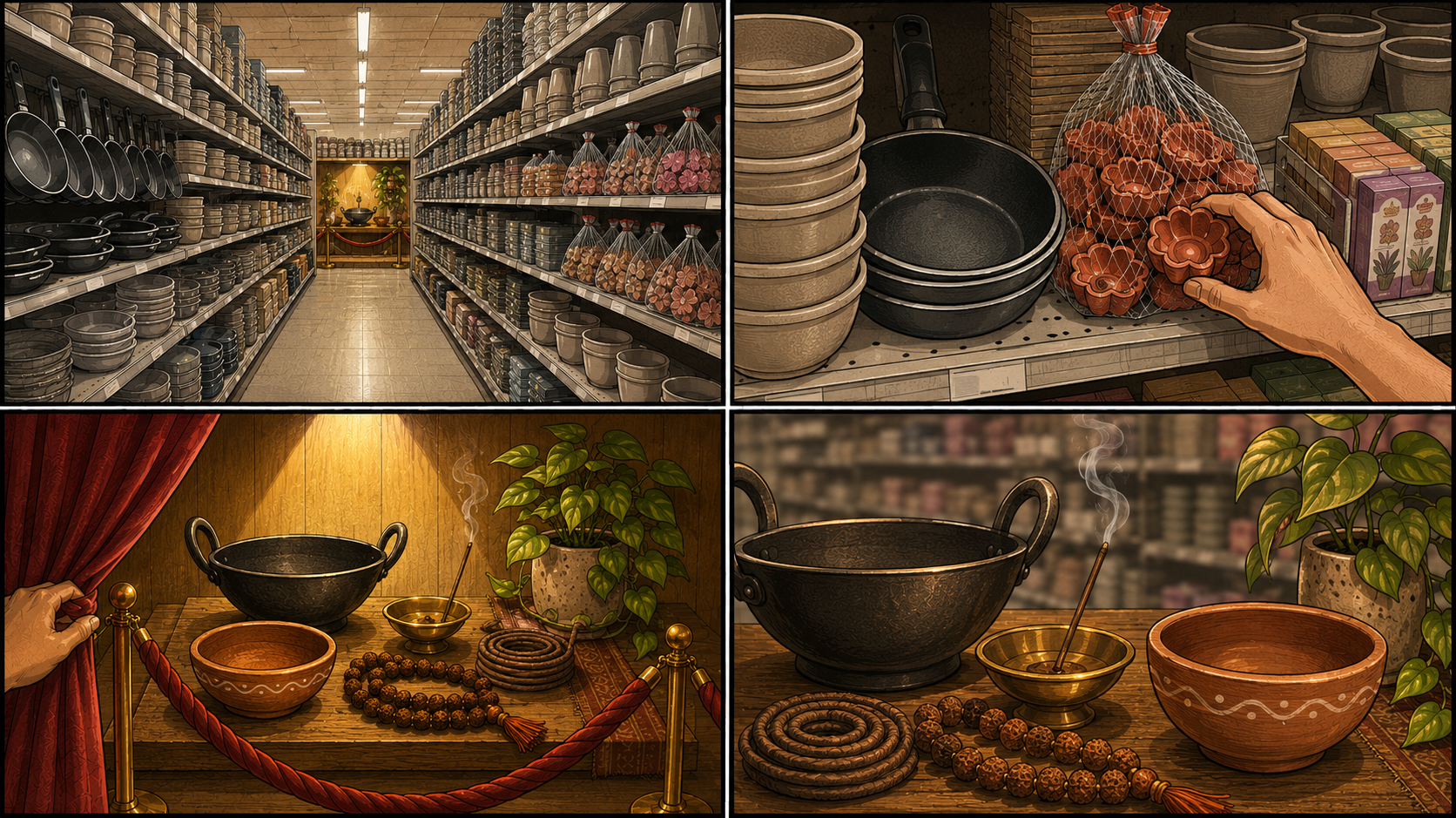
For about two decades, the Indian home quietly outsourced itself. The cast iron kadai your grandmother swore by got replaced with a nonstick pan from a mall. The temple flowers that used to become nothing in particular started going straight into a landfill instead of a life after the puja. The terracotta diya gave way to a plastic one shaped like a diya, sold in a pack of twelve.
None of this happened out of malice. It happened because cheap and available won, quietly, for a long time.
A newer set of Indian founders has been going back for the things that got left behind — not out of nostalgia, but because the originals were usually better, and because there is a real business in bringing them back at a price and a design sensibility that fits a modern home. Some of them are working with material. Some are working with ritual. A few are doing both at once.
Six Indian home and lifestyle D2C brands worth your time.
The Indus Valley
Cast iron cookware has an image problem in India that has nothing to do with how well it actually cooks. It is heavy, it needs seasoning and it rusts if you are careless with it. Three facts that sent an entire generation of Indian kitchens toward nonstick instead, even though nonstick was never the healthier choice.
Madhumitha Uday Kumar and Jagadeesh Kumar, a husband-wife team, built The Indus Valley in 2016 on the bet that Indian cooks would come back to cast iron, clay, and other traditional materials if the products were made properly and explained clearly. The catalogue now spans cast iron kadais and tawas, tri-ply stainless steel, wood, clay, copper, brass and bronze and the most recent product, the stainless steel lunch box. A genuinely wide material range for a single cookware brand, and one that lets the company sell to someone upgrading their everyday tawa and someone furnishing a kitchen from scratch in the same catalogue.
The brand has sold over 10 lakh products and holds ISO 9001 certification, which is a meaningful claim in a cookware category where quality control varies enormously between sellers. What The Indus Valley is really selling is confidence, the seasoning guide, the care instructions, the reassurance that cast iron is not actually high-maintenance once you understand it. That education layer is arguably the harder part of the business to build, and it is the part that keeps customers from abandoning the pan after the first rust spot.
Explore The Indus Valley on D2C Bazaar →
Nirmalaya
Every day, Indian temples generate an enormous quantity of flower waste, marigolds, roses, jasmine, offered in devotion and then, almost always, thrown away. Bharat Bansal, Surbhi Bansal, and Rajeev Bansal looked at that waste stream and saw a raw material nobody was using.
Nirmalaya, founded in Delhi in October 2020, collects floral waste from over 300 partner temples and converts it into charcoal-free incense using a process patented with CSIR-CIMAP, a government research institute. The brand recycles roughly 500 tonnes of floral waste a year and employs more than 40 underprivileged women in the conversion process. This is the kind of supply chain that is genuinely difficult to fake or shortcut, since it depends on real relationships with real temples at real volume.
The charcoal-free part matters more than it sounds. Most commercial incense in India is charcoal-based, which means the fragrance is doing a lot of work covering up what is actually burning. Nirmalaya’s proposition is that incense made from actual flowers, without a charcoal base, burns cleaner and smells like what it is rather than like a chemical approximation of it. It is a rare example of a waste-management problem and a genuinely nicer product turning out to be the same solution.
Explore Nirmalaya on D2C Bazaar →
Japam
Rudraksha has always sat in a specific corner of Indian life, the puja room, a grandfather’s wrist, an object of devotion rather than design. Ritoban Chakrabarti’s Japam, founded in 2022, is built on the idea that rudraksha and other spiritual objects deserve the same design attention that any modern accessory or home object gets, without losing what makes them spiritual in the first place.
The catalogue spans wearable rudraksha pieces, puja accessories, and home decor, positioned less as religious merchandise and more as objects you would actually want visible in your home or on your person. The brand has built this into a genuine business, roughly ₹30 crore in annual revenue and 35,000 monthly customers, which suggests the “design-forward spiritual object” category was underserved rather than nonexistent.
What Japam is doing well is refusing to pick a side between reverence and aesthetics. A lot of spiritual-adjacent product design either goes fully devotional (and ends up looking dated) or fully secular (and loses the thing that made it meaningful). Japam’s catalogue tries to hold both at once.
Kyari
The pandemic turned an enormous number of Indians into first-time plant owners, and a similarly enormous number of those plants died within a few months, usually from a mix of overwatering, underwatering, and general uncertainty about what the plant actually needed.
Agam Choudhary and Saksham Jain founded Kyari in Indore in April 2022 to solve exactly that problem. Indoor plants sold alongside self-watering planters and the actual guidance a first-time plant owner needs to keep something alive past the first month. The self-watering planter is the quiet engineering win here: it removes the single most common failure point (guessing at watering frequency) without requiring the owner to become a hobbyist.
The brand has grown revenue from roughly ₹1.75 crore to ₹9.8 crore, a 460 percent increase that reflects how large the underserved “I want plants but I keep killing them” market actually was. Kyari’s real product is not the plant. It is the system around the plant that makes it survivable for someone who has never kept one alive before.
Nestasia
Home decor in India has historically had an uncomfortable gap in the middle. A ₹200 plastic bowl on one end, a ₹3,000 designer piece on the other, and not much serving the buyer who wants something that looks considered without requiring a special occasion to justify the price.
Aditi Murarka Agrawal and Anurag Agrawal founded Nestasia in Kolkata in 2019 to build directly into that gap, sourcing home decor and lifestyle products from Indian artisans and across Southeast Asia. The brand has crossed one million orders and now operates seven exclusive stores, with plans to expand to thirty by the end of 2025. A genuinely fast build-out for a decor brand, and one backed by a $4 million Series A followed by an $8.35 million follow-on round.
One honest note: because part of the catalogue is sourced from Southeast Asia rather than made in India, Nestasia does not carry a “Made in India” label the way some of the other brands here do. What it does carry is a consistently design-conscious eye across a wide catalogue, at a price point that does not ask the buyer to treat a bowl as an investment piece.
Explore Nestasia on D2C Bazaar →
Ellementry
Ayush Baid grew up around his father Dileep Baid’s handicraft export business, watching thirty years of beautifully made Indian terracotta, marble, wood, metal, and glass pieces get shipped out to foreign buyers who never knew the maker’s name. Ellementry, founded in Jaipur in September 2018, is Ayush’s answer to that arrangement, the same manufacturing base, sold directly to Indians instead of exported away from them.
Ellementry describes itself as India’s first vertically integrated D2C homeware brand, meaning it controls production from raw material to finished product rather than assembling a catalogue from third-party manufacturers. That control shows up in the numbers: ₹18.7 crore in FY25 revenue, a 48 percent repeat purchase rate, over 250,000 customers, and 16 stores across 13 cities and 12 countries.
The 48 percent repeat rate is the number worth sitting with. Home decor is not a category with an obvious reason to come back, you do not need a new coffee table every quarter. A repeat rate that high suggests people are building out a full aesthetic across multiple purchases, one piece at a time, which is a very different relationship with a brand than a one-off gift purchase.
Explore Ellementry on D2C Bazaar →
There are more home & lifestyle brands worth exploring on D2C Bazaar → Indian Home and Lifestyle D2C brandsWhich Indian D2C home and lifestyle brands are worth knowing?
The Indus Valley for cast iron and traditional-material cookware, Nirmalaya for charcoal-free incense made from recycled temple flowers, Japam for design-forward rudraksha and spiritual home objects, Kyari for indoor plants with self-watering planter systems, Nestasia for accessible design-led home decor, and Ellementry for vertically integrated, handcrafted homeware from Jaipur.
Is there a good Indian D2C brand for traditional cookware like cast iron?
The Indus Valley makes cast iron kadais and tawas alongside tri-ply stainless steel, wood, clay, copper, brass, and bronze cookware. Founded in 2016 by Madhumitha Uday Kumar and Jagadeesh Kumar, the brand has sold over 10 lakh products and is ISO 9001 certified, with a strong focus on educating buyers on cast iron seasoning and care.
What is a sustainable Indian incense brand?
Nirmalaya makes charcoal-free incense from floral waste collected at over 300 partner temples across India, using a process patented with CSIR-CIMAP. The brand recycles around 500 tonnes of temple flower waste a year and employs more than 40 underprivileged women in the process.
Are there Indian D2C brands for indoor plants?
Kyari sells indoor plants along with self-watering planters designed to solve the most common reason first-time plant owners fail — inconsistent watering. Founded in Indore in 2022 by Agam Choudhary and Saksham Jain, the brand has grown revenue by 460 percent since launch.
What are good Indian D2C home decor brands?
Nestasia and Ellementry both cover home decor from different angles. Nestasia, founded in Kolkata in 2019, sources design-led decor from Indian artisans and Southeast Asia at accessible prices. Ellementry, founded in Jaipur in 2018, is a vertically integrated manufacturer selling handcrafted terracotta, marble, wood, metal, and glass pieces directly, with a 48 percent customer repeat rate.
What are Indian D2C home and lifestyle brands?
Indian D2C home and lifestyle brands sell homeware, decor, cookware, and lifestyle objects directly to consumers online, without going through traditional retail. Many of the more interesting ones in this category are reviving Indian materials and craft traditions — cast iron, terracotta, temple flowers, rudraksha — that had been displaced by cheaper mass-produced alternatives, and rebuilding them with modern design and direct-to-consumer pricing.
Comments